


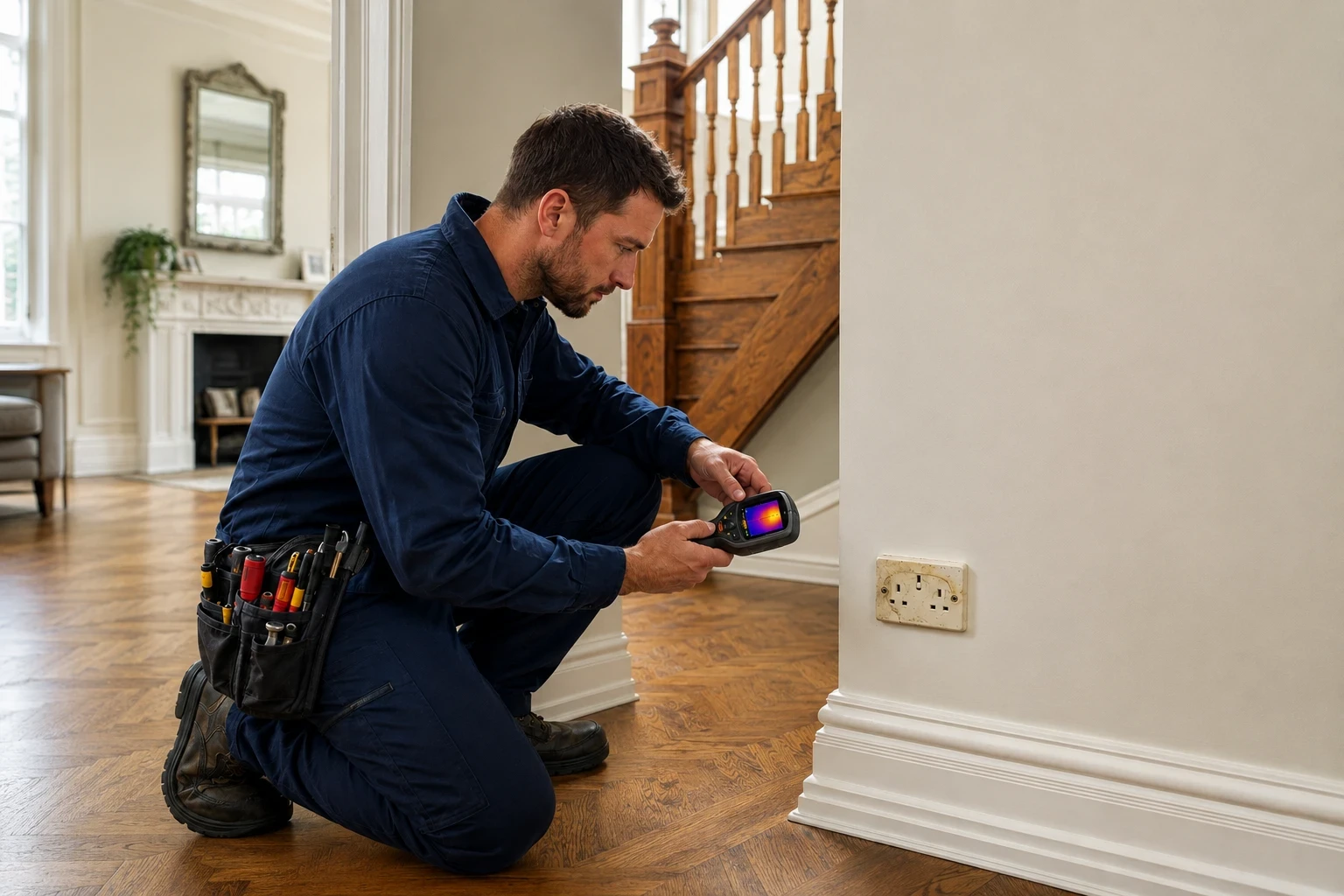
Electrical problems are not always obvious. A socket may suddenly stop working, lights might flicker without explanation, a fuse box may repeatedly trip, or part of a property may lose power while everything else continues working normally.
Finding the source of these problems requires more than simply replacing the component showing the symptoms. Electrical fault finding is a systematic process electricians use to locate the underlying cause of an electrical problem before carrying out the appropriate repair.
Professional fault finding is particularly important when faults are intermittent, hidden within wiring or affecting multiple circuits. Emergency Electrician Services uses professional diagnostic equipment to identify electrical faults affecting homes, landlords and businesses.
This guide explains how electrical fault finding works, what problems electricians can diagnose and when an electrical fault requires urgent attention.
What Is Electrical Fault Finding?
Electrical fault finding is the process of inspecting, testing and diagnosing an electrical installation to determine why something is not working correctly.
Instead of guessing which component needs replacing, an electrician systematically investigates the electrical system until the faulty circuit, connection, appliance or component is identified.
Electrical fault finding may be required when you experience:
– Repeatedly tripping electrics
– Partial or complete power loss
– Sockets that suddenly stop working
– Flickering lights
– Lighting circuits failing
– Burning electrical smells
– Buzzing or crackling sounds
– Consumer unit problems
– Electrical equipment repeatedly cutting out
– Intermittent electrical faults
The aim is to find the actual cause rather than simply addressing the visible symptom.
Why Is Professional Electrical Fault Finding Important?
Electrical systems can be complex. The location where you notice a problem is not necessarily where the fault originates.
For example, a socket that stops working could potentially be caused by the socket itself, damaged wiring elsewhere on the circuit, a loose connection or a protective device operating within the consumer unit.
Similarly, lights that repeatedly flicker could indicate a defective fitting, faulty switch, wiring issue or loose electrical connection.
Accurate diagnosis helps electricians determine what needs repairing while avoiding unnecessary replacement of components that are still functioning correctly.
What Are the Most Common Electrical Faults?
Electricians encounter many different faults in domestic and commercial electrical installations. Some problems develop gradually, while others occur unexpectedly.
Tripping Fuse Box or Consumer Unit
Repeated tripping is one of the most common reasons electrical fault finding is required.
Protective devices within the consumer unit are designed to disconnect a circuit when certain problems occur.
Possible causes include:
– Faulty appliances
– Overloaded circuits
– Damaged wiring
– Moisture
– Loose connections
– Consumer unit problems
Emergency Electrician Services advises that repeatedly resetting a tripping fuse box without investigating the cause can leave an underlying problem unresolved.
Partial Power Loss
Sometimes an electrical fault affects only one section of a property.
You might discover that upstairs sockets work while downstairs sockets do not, or one room has electricity while another has completely lost power.
An electrician can test the affected circuits to establish where electricity is being interrupted.
Complete Power Loss
A complete loss of electricity could originate from the property’s electrical installation or from an external supply problem.
If neighbouring properties still have electricity while yours does not, professional investigation may be necessary.
Internal causes can include tripped circuits, consumer unit faults, wiring problems and overloaded systems.
Faulty Electrical Sockets
A socket may stop working because of a problem within the accessory or elsewhere on its circuit.
Warning signs can include:
– No electricity from the socket
– Intermittent operation
– Buzzing noises
– Burning smells
– Heat
– Discolouration
– Sparking
Professional testing can help determine whether the socket, wiring or another part of the circuit requires attention.
Lighting Faults
If replacing a bulb does not solve the problem, there may be an electrical fault.
Common causes of lighting problems include faulty switches, damaged wiring, defective light fittings, tripped circuits and fuse box problems.
Burning Smells and Overheating
A burning electrical smell requires particular attention because it can indicate overheating wiring, damaged cables, loose connections, overloaded circuits or faulty electrical components.
Do not attempt to locate overheating wiring by removing electrical accessories yourself.
How Do Electricians Diagnose Electrical Problems?
Professional fault finding usually follows a logical process. The exact procedure depends on the symptoms, property and electrical installation.
Step 1: Understanding the Electrical Problem
The electrician will normally begin by asking what has happened.
Useful information might include:
– When the fault started
– Which rooms are affected
– Whether the fault is constant or intermittent
– Whether the consumer unit has tripped
– What appliances were operating beforehand
– Whether you noticed sparks, smells or unusual sounds
– Whether previous electrical problems have occurred
Even small details can help narrow down where the electrician should begin testing.
Step 2: Visual Electrical Inspection
The electrician may then visually inspect relevant parts of the electrical installation.
They may look for signs such as:
– Damaged electrical accessories
– Loose sockets
– Burn marks
– Overheating
– Damaged cables
– Moisture
– Discolouration
– Signs of previous electrical work
A visual inspection can sometimes immediately reveal the likely source of the problem.
However, many electrical faults are hidden, which is why further testing is often necessary.
Step 3: Checking the Consumer Unit
The consumer unit is often an important part of electrical fault diagnosis.
An electrician can check which protective device has operated and determine which circuit is associated with the problem.
For example, the fault may be isolated to:
– Socket circuits
– Lighting circuits
– Kitchen electrics
– Outdoor circuits
– Heating equipment
– Other dedicated electrical circuits
Narrowing the problem to a specific circuit makes further investigation more efficient.
Step 4: Isolating the Faulty Circuit
Once the electrician identifies the likely circuit, they can systematically narrow down the location of the fault.
Different appliances, accessories or sections of wiring may need to be isolated to establish which component is responsible.
This process helps prevent unnecessary work elsewhere in the electrical installation.
Step 5: Electrical Testing
Electricians use appropriate professional testing equipment to investigate electrical circuits safely.
Depending on the problem, testing can help identify issues involving wiring, insulation, connections, circuits and protective devices.
Emergency Electrician Services states that its electricians use professional fault-finding and diagnostic equipment to identify faults and carry out appropriate repairs.
Step 6: Identifying the Root Cause
Once testing has narrowed down the problem, the electrician can establish what is causing the fault.
For example, what initially appeared to be a faulty socket might actually be a damaged connection elsewhere on the circuit.
Finding the root cause is important because repairing only the visible symptom could allow the problem to return.
Step 7: Repairing the Electrical Fault
After identifying the problem, the electrician can explain what repair is required.
Depending on the diagnosis, this could involve:
– Replacing a damaged socket
– Repairing faulty wiring
– Replacing a defective switch
– Repairing a lighting circuit
– Addressing a consumer unit problem
– Replacing a faulty protective device
– Repairing loose electrical connections
– Isolating defective electrical equipment
Emergency Electrician Services aims to diagnose and repair many emergency electrical problems during the first visit where possible.
Step 8: Testing After the Repair
Electrical fault finding should not necessarily finish when the damaged component is replaced.
The repaired circuit may need to be tested to verify that the problem has been resolved and that the affected electrical system is operating correctly.
This final stage helps confirm that the original fault has been addressed rather than temporarily masked.
What Is an Intermittent Electrical Fault?
Intermittent electrical faults can be particularly difficult to identify because the problem may appear and disappear.
For example:
– Lights occasionally flicker
– A circuit trips only sometimes
– A socket works intermittently
– Electricity cuts out before returning
– A problem appears only when a particular appliance operates
Because the fault may not be present continuously, careful investigation and testing are important.
Keep track of when the problem occurs and what electrical equipment was operating at the time. This information may help your electrician narrow down the cause.
Can Faulty Appliances Cause Electrical Problems?
Yes. Sometimes the property’s fixed electrical installation is not responsible for the problem.
A defective appliance may cause a circuit or protective device to trip when it is connected or switched on.
If you notice that the electrical problem consistently occurs when using a particular appliance, stop using it until the cause has been established.
Do not continue repeatedly resetting a breaker simply to keep using equipment that appears to trigger the problem.
When Does an Electrical Fault Become an Emergency?
Some faults can be investigated through a routine appointment, but others require urgent attention.
Consider contacting an emergency electrician if you notice:
– Burning electrical smells
– Smoke
– Sparks
– Exposed wiring
– Significant power loss
– Repeatedly tripping circuits
– Hot sockets or switches
– Buzzing or crackling sounds
– Electrical shocks
– Water around electrical equipment
Burning smells, sparking outlets, repeated tripping and unexpected power loss can indicate faults requiring prompt professional attention.
Why Should You Avoid DIY Electrical Fault Finding?
Electrical fault finding requires knowledge of electrical systems, safe isolation procedures and appropriate testing equipment.
Attempting to dismantle sockets, consumer units or electrical fittings without suitable competence can expose you to electrical hazards and potentially make the original problem worse.
There are some basic observations you can safely make, such as noting which rooms are affected or whether a particular appliance appears to trigger a fault.
However, testing and repairing fixed electrical installations should be left to a qualified professional.
Electrical Fault Finding for Commercial Properties
Electrical faults can be particularly disruptive for businesses.
A circuit problem can affect:
– Lighting
– Computers
– Point-of-sale equipment
– Machinery
– Security systems
– Refrigeration
– Communications
– Other essential electrical equipment
Fast and accurate diagnosis helps identify the problem while reducing unnecessary disruption to unaffected areas.
Emergency Electrician Services provides fault finding and emergency electrical repairs for both residential and commercial properties.
What Information Should You Give an Electrician?
Providing clear information can help the electrician understand the problem before arriving.
Try to explain:
– What stopped working
– When the fault started
– Whether the problem has happened previously
– Which rooms or circuits are affected
– Whether anything trips
– Whether you noticed smells, heat, sparks or noises
– Whether a particular appliance triggers the fault
Do not put yourself at risk to gather this information. If there are sparks, smoke, exposed wiring or other obvious hazards, keep away from the affected area.
How Can Electrical Fault Finding Prevent Bigger Problems?
Electrical faults rarely improve by themselves.
Problems such as loose connections or damaged wiring may deteriorate over time. Warning signs including flickering lights, burning smells, buzzing sounds, warm sockets and repeated tripping should therefore not simply be ignored.
Early professional diagnosis can help locate the problem before it leads to repeated power interruptions, additional damage or a more serious electrical safety concern.
